Designing for Scale: A 94% Efficiency Gain in Tenant Placement
We turned a chaotic, in-person leasing process into a fully automated flow — cutting placement time from 2.5 weeks to just one day.
March 24, 2025
10 min read
A zero-to-one project, 4-week design, and 4-month development. Inclusive of email automation, cross-functional team engagement.
The goal of this project was to streamline the application process for potential tenants seeking to rent properties on our platform. By designing an integrated flow across three distinct products, we aimed to eliminate the need for local estate agents and scale a traditionally operationally heavy process.
The key objectives were to ensure an efficient, user-friendly process for tenants while automating key property management tasks for internal teams.
The Problem: Too Much Work. Too Little Time.
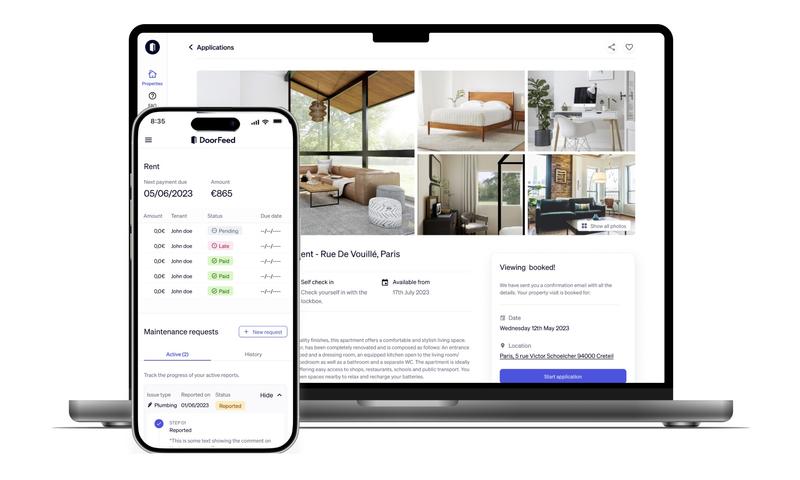
Before we began this project, renting a home through our platform meant phone calls, emails, key handovers, and hours of back and forth. The process was built for a world of local estate agents and in-person tasks, not for scaling across markets.
- Tenants were dropping off halfway through the process.
- Property managers were drowning in admin.
- Vacancies dragged on, costing investors time and money.
It wasn’t broken. But it was breaking.
The real challenge?
To reimagine the entire tenant journey across three disconnected platforms and create a seamless, automated flow that could scale without adding headcount.
We had to rethink everything:
- Viewings
- Document collection
- Due diligence
- Payments
- Key handovers
And we had to do it without compromising compliance, security, or user experience.
“The first step was to map the chaos. Only then could we find the way out.”
Research
The first step was listening. I sat down with our property manager and operations team, not just to hear their requirements but to understand their daily friction. What felt repetitive? Where did they lose time? What caused the most frustration when juggling multiple applicants?
It became clear that the existing process was not only manual but also mentally scattered. Important steps like document verification and deposit collection were happening across different tools; they were happening across people’s memories. Everyone had their own “system,” and that made scale impossible.
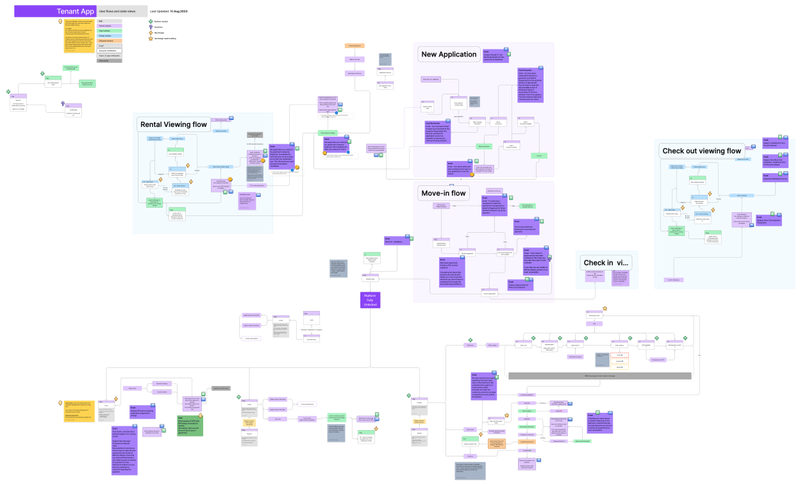
So I stepped back. I mapped out the entire process in a state diagram—every user interaction, every approval gate, every dead end. It was messy, and that was the point. Seeing the chaos laid bare helped us spot the friction: where applicants stalled, where tasks slipped through the cracks, and where internal teams were left guessing what to do next.
One surprising insight: even the email flow caused anxiety. People weren’t sure whether they had submitted everything, and property managers often followed up manually, sometimes twice or thrice. That tiny pain point helped shape one of our most powerful features: intelligent, persuasive email automation tied directly to each workflow state.
By the end of the research phase, the team had not only a shared understanding of the process, we had a shared language for how to fix it.
Ideation and Design Process
Design began with flow. Using Figma Jam, I ran collaborative sessions to map the tenant journey end-to-end, identifying key touch points where delays or confusion occurred.
From there, we restructured everything: how viewings were scheduled, documents were gathered, and applications were reviewed. The goal wasn’t just clarity; it was momentum. Each screen, form, and email had to guide the user to the next step without friction.
With every iteration, I incorporated feedback from property managers, operations, and engineers, tightening the loop between design and decision-making. High-fidelity designs followed quickly, supported by live prototypes and system flows that brought the experience to life across our three products.
- Tenant Platform:
-
The system had to be maximally automated; to reduce times drastically, we had to
re-imagine the process.
- This meant viewings had to be on-demand, a significant change from traditional methods.
-
Due diligence information was required in advance, and documents must be submitted
for review as a priority for applications to be approved.
- This meant prompting the applicants to submit forms early with persuasive language and unique email automation.
- The form layout and information hierarchy are necessary based on application requirements. The form fields must be clear and accessible to reduce submission errors.
- Once an application was approved, paying a deposit and pro rata rent, setting up payment schedules, reviewing inventory, and receiving keys had to be massively streamlined.
- Transitioning tenants had to be smooth and partially automated, with windows for check-in and out.
-
The system had to be maximally automated; to reduce times drastically, we had to
re-imagine the process.
- Investment Platform:
- We needed to create specific workflow features, such as reviewing submitted documents, receiving deposits, and organising key collections.
- Create a dashboard for property managers to track application statuses and assign tasks.
- Viewer App:
- Create rental viewings that allow the viewer to access the keys, let the applicants into the property and close up upon completion.
- Check-in flows for recording inventories upon exit and entry.
High-fidelity designs were created in Figma, incorporating feedback from stakeholders at each iteration.
How we improved the Tenant Placement Process
We improved the applicant experience in two key ways, providing instant availablity for viewings and streamlining the application process for both tenant and property manager.
Instant availability for viewings
Applicants can instantly schedule and attend viewings, reducing the need for in-person interactions.
Hover to play
Streamlined applications
Users can apply remotely and upload documents to our portal for due diligence. Traditional due diligence is done via email, which can become a hassle for the property manager with many applicants. By automating these steps, we radically reduced processing time.
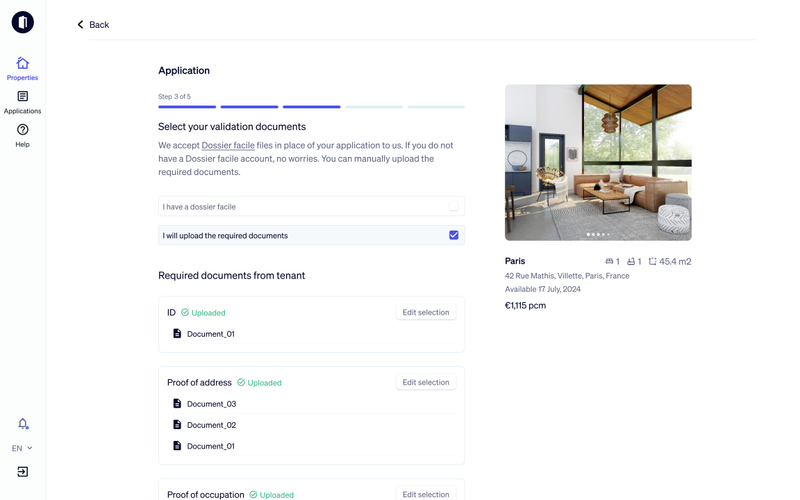
Verification of credit, employment, and rental history from one hub eliminates manual delays.
Hover to play
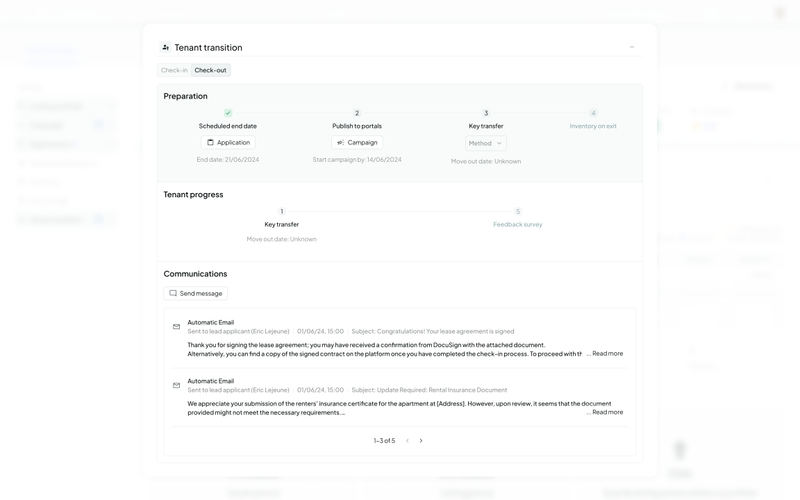
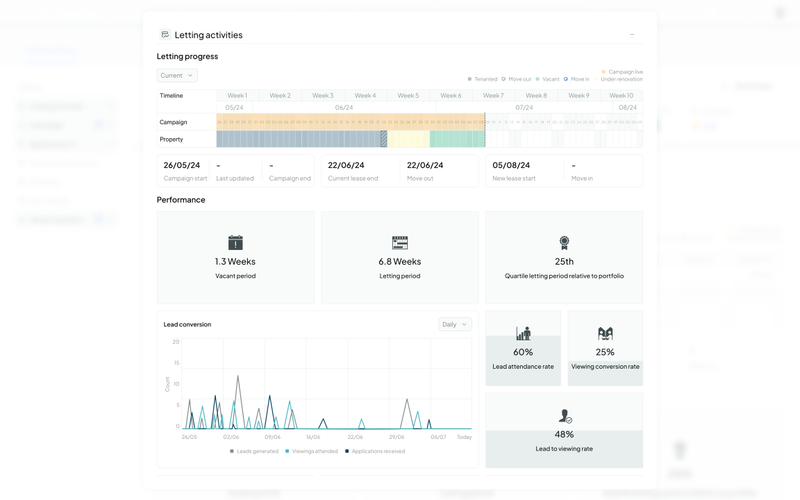
The final design integrated all tech solutions within the DoorFeed product; Tenant Platform, Investment Platform, and Viewer App. Enabling a seamless flow for tenants and property managers.
Successful applicants could now complete the entire application process, from form submission to key collection, without requiring in-person interactions. Internal teams could manage tasks remotely, enhancing efficiency and scalability.
Handover
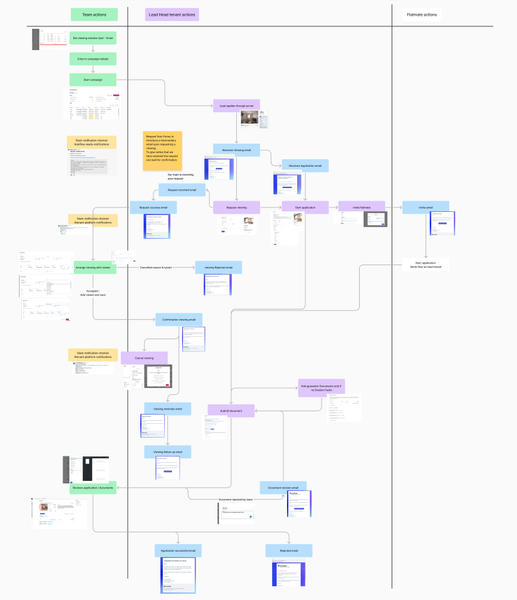
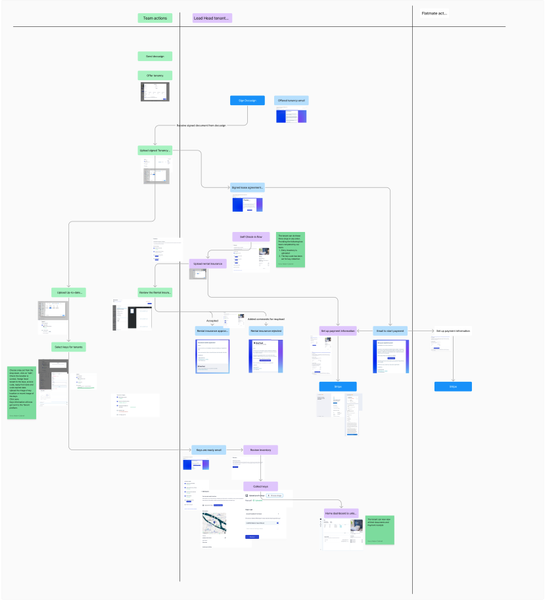
Due to the complexity of the product, three apps integrated at different stages of the flow and 3rd party apps such as Hubspot, stripe and the inventory app, it was imperative that I mapped out the entire process for the property manager, and engineering team.
Impact: From 2.5 Weeks to 1 Day
This project didn’t just improve the tenant application process—it redefined it.
94% Faster Placement
What once took up to 17 days, including viewings, document chasing, approvals, and key handovers, now happens in less than 24 hours. Tenants can move from viewing to signed lease with zero in-person interactions.
"We got an application, reviewed the documents, and issued a tenancy all in one afternoon.”
Operational Flow, Automated
Manual tasks that slowed property managers down are now handled through automated workflows, email triggers, and an integrated dashboard. There is no more digging through inboxes or chasing paperwork.
- Tasks assigned automatically
- Compliance checks run in the background.
- Key logistics handled by app-based handovers
Big Wins for Big Investors
For large-scale property owners, time is money. By compressing the placement window, we helped:
- Minimise vacancy loss
- Increase portfolio throughput
- Standardise compliance across hundreds of units
By transforming tenant placement from a weeks-long process into a seamless, one-day experience, we provide institutional investors with a competitive edge in property management.
Reflection
This project was a masterclass in complexity, and clarity.
What looked, on the surface, like a simple form redesign quickly revealed itself to be a deep system challenge. We weren’t just building features. We were stitching together three products, a network of third-party integrations, and a team of stakeholders who all had slightly different views of how the process should work.
The hardest part wasn’t the design itself. It was the translation: turning spoken needs, scribbled workflows, and edge-case chaos into a single, coherent flow that made sense to both engineers and operators. I learned quickly that documentation isn't just a deliverable. It’s a leadership tool. The swim-lanes and process maps I created didn’t just help us ship. They helped align minds.
There was a moment halfway through when the integrations started to pile up, and the logic was turning into spaghetti it felt like we might have overreached. But that was also the turning point. I leaned into the mess, broke things down into first principles, and rebuilt the flows around user needs, not internal assumptions.
I take forward this: when you're building zero-to-one, your job is part strategist, part translator, and part editor. You make the complex feel simple. Not by dumbing it down, but by seeing the whole, then telling the story clearly enough for others to act on it.